

2026 NATIONAL RESEARCH STUDY · 1,000 U.S. WORKERS
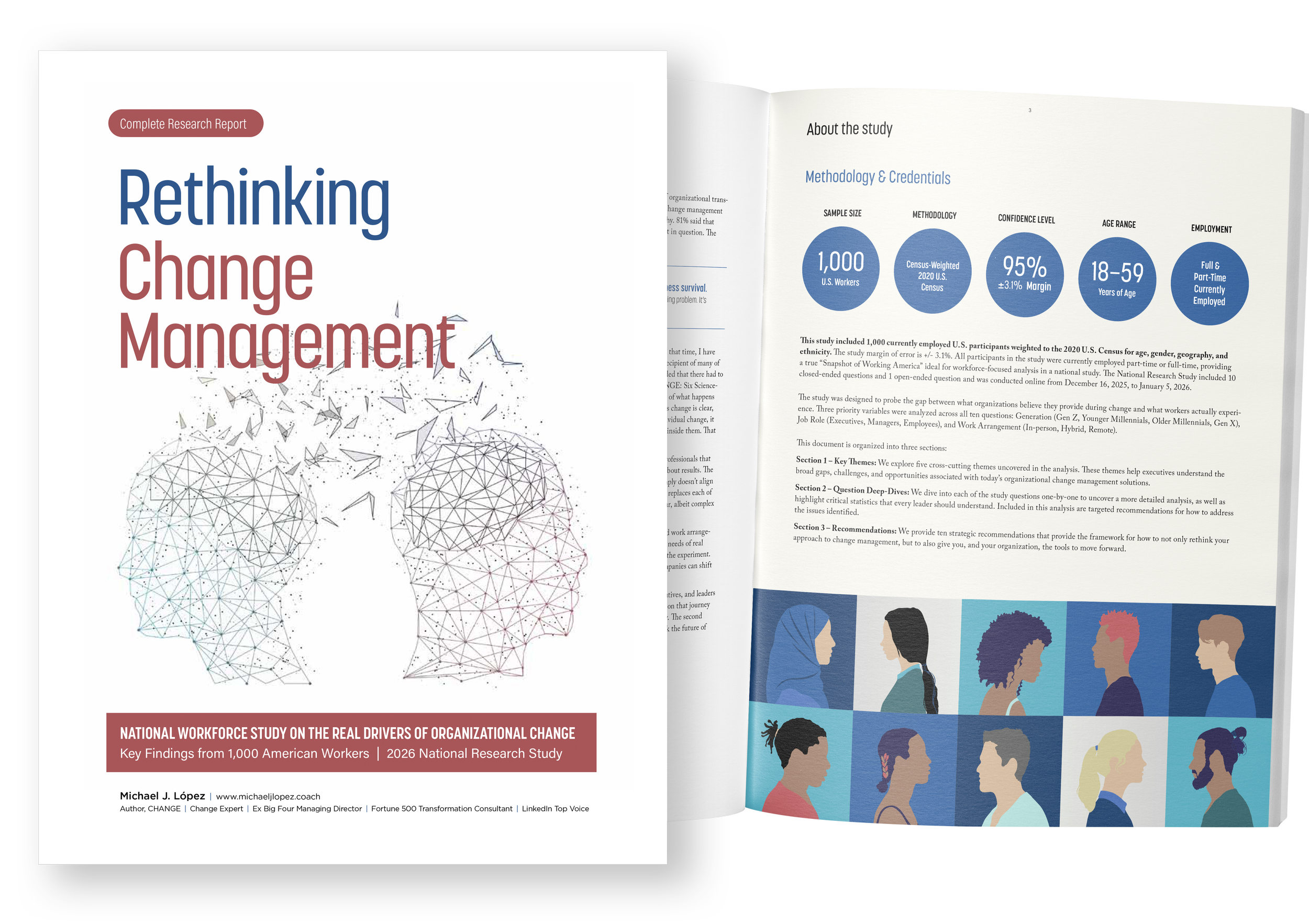
Census-weighted sample · +/-3.1% margin of error · 95% confidence level
Rethinking Change
Management
Organizations have been solving the wrong problem. We asked 1,000 workers what actually works.
For decades, roughly 70% of organizational transformations have failed. Not for lack of investment. Organizations have been designing change for organizational convenience, not for the humans doing thechanging. This study asked 1,000 American workers what is actually going on.
Five Themes Dominate the Research
The study uncovered five themes that uncover why we have been unable to improve the success rate of organizational transformation. These themes represent important systemic patterns in the world of organizational change that, if addressed, could dramatically improve the experience of employees and the performance of organizations. While these themes are complex, and interconnected, they also present organizations with the recipes for success.
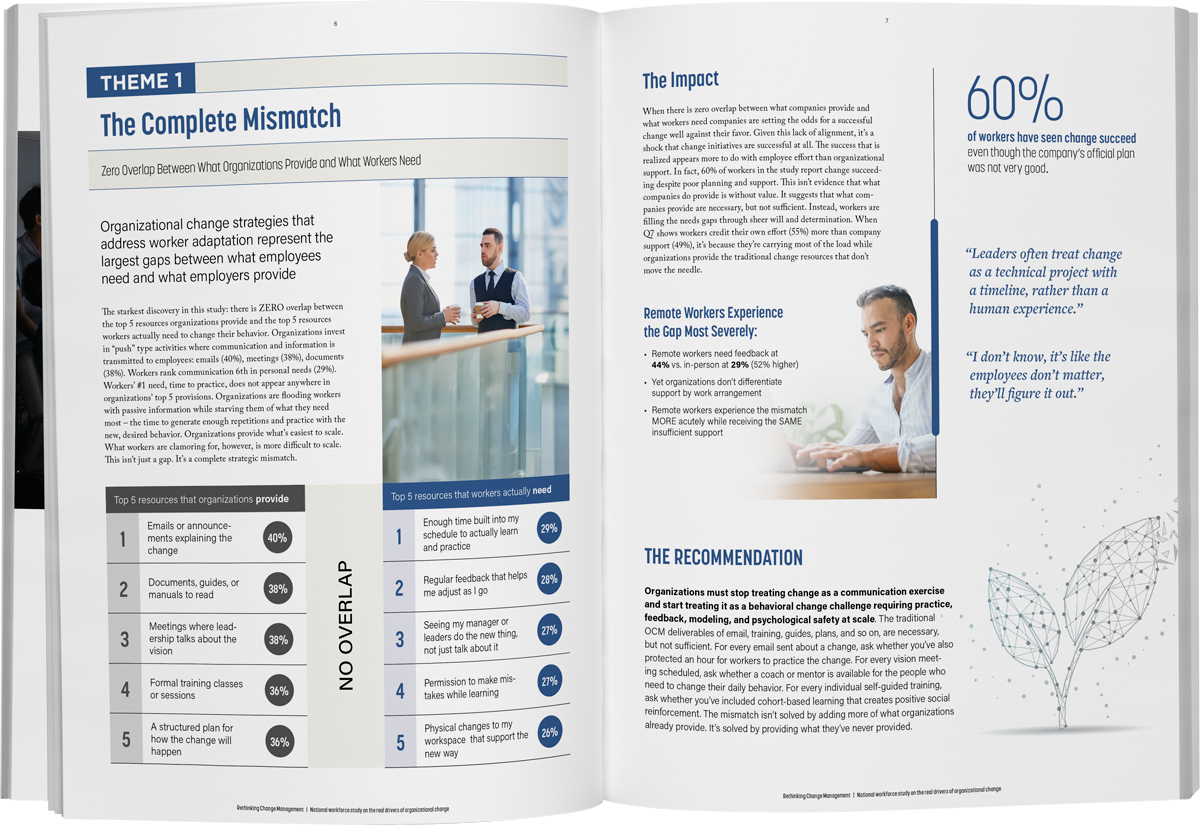
Zero overlap. Not a gap. Zero.
The most striking finding in the study
“Leaders often treat change as a technical project with a timeline, rather than a human experience.”
When we asked workers what resources organizations provide during change and what resources they actually need, we expected to find a gap. Everyone expected a gap. What we did not expect was a complete absence of any overlap at all. The top five resources organizations provide: emails, documents, meetings, training, and structured plans. The top five resources workers need: time to practice, regular feedback, leadership modeling, permission to fail, and a coach. Not one item in common.
Organizations are not making bad decisions with good information. They are making predictable decisions based on what is easiest to measure and deliver at scale. Emails are easy to send and track. Training completion rates are easy to report. What workers need is harder to build and harder to quantify. But the data is unambiguous about which approach actually produces behavior change.
Dive into game changing statistics.
Every failed change leaves
a trust deficit behind.
59% of workers have lost trust in leadership because of how a change was handled
The failure of organizational change initiatives is typically measured in ROI, adoption rates, and project timelines. This study suggests those metrics are missing the most consequential cost. When change is handled poorly, the damage extends well beyond the initiative itself. Fifty-nine percent of workers have lost trust in their company leadership because of how a change was handled. That trust does not automatically return when the next initiative launches. It compounds.
The minimization cycle this study documents helps explain why. Leaders pitch changes as simple to get approval. Projects launch under-resourced. They fall short. Workers who were told it would be easy are left wondering if they were misled or if they themselves failed. Cynicism builds. The next initiative requires even more minimization to overcome existing skepticism. Each cycle makes the next change harder to execute and harder to believe in.
“Honestly, it feels like no one expects change to work anymore.”
Get these findings and much more
The complete research report goes deeper on every one of these numbers. Inside, you will find a full description of all five themes, a question-by-question analysis of what 1,000 workers said, and ten recommendations every business leader needs to know. The recommendations are grounded in the neuroscience of how adults actually change behavior. Not frameworks. Not theory. Science.
What is inside the full report:
Five theme deep-dives with demographic breakdowns and worker voices
Ten question-by-question analyses with generational and role-based comparisons
Ten strategic recommendations for CEOs and senior leaders
The neuroscience behind each recommendation and why it works
Verbatim responses from 1,000 workers on why change keeps failing
Start with the Executive Summary
Not ready for the full report? The Executive Summary gives you the five key findings and what they mean for your organization. No frameworks. No upsell. Just the data and the implications.
The complete mismatch between what organizations provide and what workers need
Why Gen X leadership is designing change for 30% of the workforce
The minimization cycle that keeps failure rates at 70%
What workers say actually works. And why it is not in your current playbook.
Three questions every CEO should be asking right now
Book Michael to present the findings
The data in this study is designed to move audiences, not just inform them. Michael J. Lopez brings the research to life for leadership teams, executive offsites, and conference audiences with a presentation built entirely around the study findings. When you have spent a decade inside the organizations this research examines, the numbers come with stories. And the stories change how leaders act.
Keynote presentations for conferences and annual meetings
Executive briefings for senior leadership teams
Workshop sessions built around the study’s ten recommendations
Custom presentations with your organization’s data alongside the national findings
Every speaking engagement includes 200 complimentary copies of the full report.
Put the research directly in the hands of your audience. Each copy gives attendees the complete data, the five theme deep-dives, and the ten recommendations they can bring back to their organizations the same day.
Media and podcast requests
Michael J. Lopez is available for podcast interviews, keynote speaking, and media commentary on organizational change, workforce research, and the neuroscience of behavior change. His perspective is grounded in more than a decade of practitioner experience inside Fortune 500 transformations and Big Four consulting.
About the Study
The 2026 National Workforce Study on the Real Drivers of Organizational Change surveyed 1,000 currently employed U.S. workers, weighted to the 2020 U.S. Census for age, gender, geography, and ethnicity. The study was conducted online from December 16, 2025, to January 5, 2026. The margin of error is +/-3.1% at a 95% confidence level. All participants were employed part-time or full-time at the time of the survey.
The study was designed to examine the gap between what organizations believe they provide during change and what workers actually experience. Three variables were analyzed across all ten questions: generation (Gen Z, Younger Millennials, Older Millennials, Gen X), job role (executives, managers, employees), and work arrangement (in-person, hybrid, remote).
© 2026 Michael J. Lopez Holdings, LLC · 1,000 U.S. respondents, census-weighted, +/-3.1% margin of error