

The plan is sound. The team is built. And yet, your people haven’t changed. Neither has performance.
Nobody told them which behaviors had to change, or gave them the chance to practice. And until your company runs entirely on AI, a real person still has to do the work your transformation depends on
I spent 20 years inside organizations responsible for making transformation work, from the intelligence community to the Big Four. Across all of it, I saw the same pattern: change designed to make executives feel in control, while the people living it feel worse. Here is what I keep coming back to. Individual and organizational change are the same science. Transformations fail because companies keep forgetting that.
I started this practice for one reason.
To change how companies change. So employees get the experience they need and the business gets the performance it wants.
LinkedIn Top Voice
•
Forbes Business Council
•
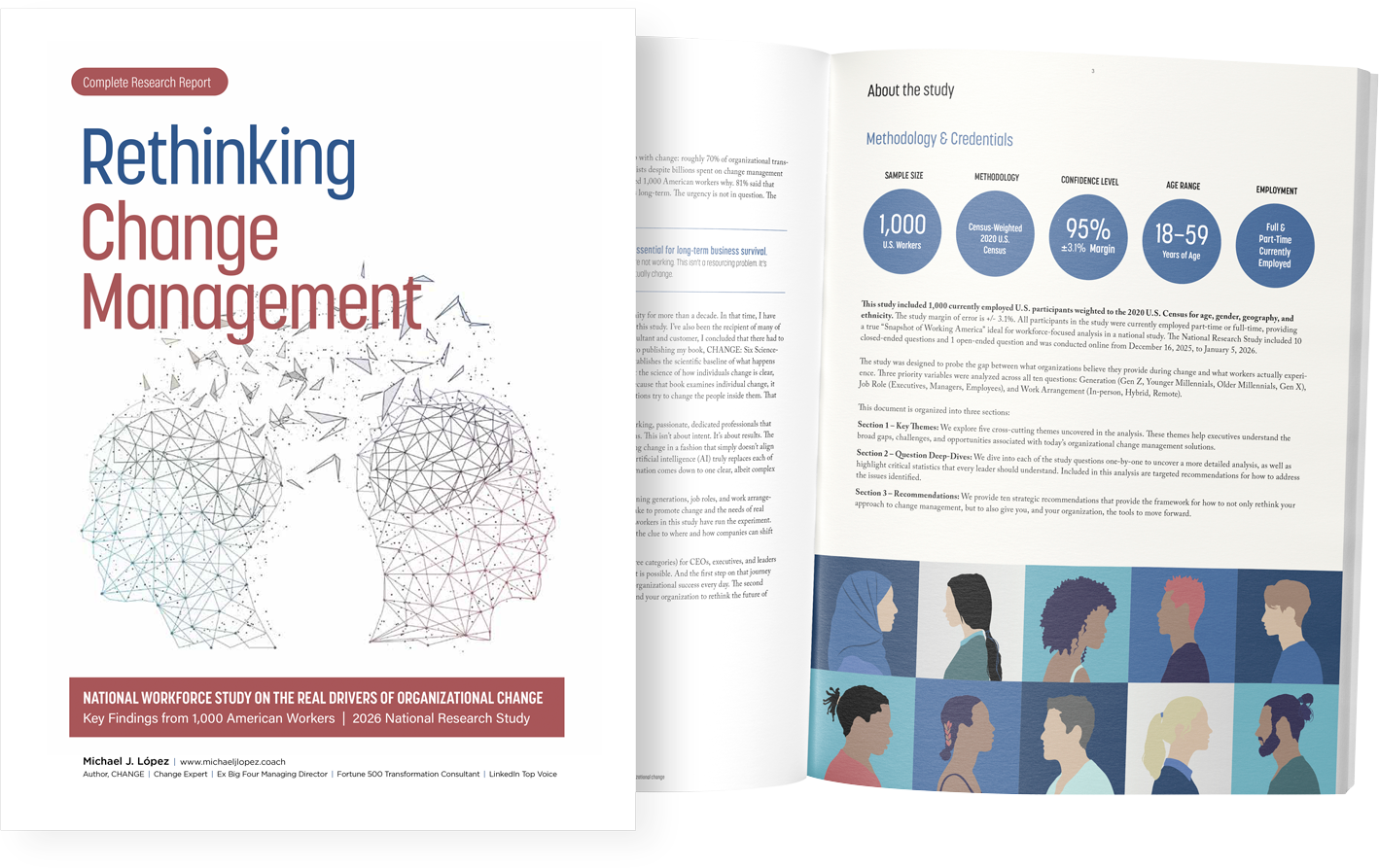
Author, Rethinking Change Management National Workforce Study
•
Author, CHANGE
•
As seen in Reuters
•
USA Today
•
Host, The Top Voice Podcast
•
LinkedIn Top Voice • Forbes Business Council • Author, Rethinking Change Management National Workforce Study • Author, CHANGE • As seen in Reuters • USA Today • Host, The Top Voice Podcast •








The Proof
How do we know employees aren't getting what they need? Because 1,000 workers told us what no one had asked them.
We asked what they need to adapt to change, and what their organizations actually provide. There was zero overlap.
Organizations send emails, deliver training, and run town halls. Workers need time to practice, honest feedback, and a coach or mentor in the room with them. Not one item in common. Everything on the first list is something done to people. Everything on the second is something done by people.
Despite decades of effort, organizations have not delivered the transformational results they promised. Your people already know what works. They are just not being listened to.
That is where real change starts.
The Proof, In Practice
One nuclear utility client came into this work rated in the bottom 10% of stations nationwide. Their teams took on five behaviors holding performance back and designed the experiments to shift them, run inside their daily work. Eight months later, at the end of my engagement, they were rated among the best in the industry, with ten of sixteen performance metrics green for the first time in the station’s history. Six months after that, running it without me, they completed a 28-day refuel outage that had gone unmet for years. Daily productivity rose 50%, and the station captured $36 million in performance upside. The performance held because the people changed how they work and it spread through the organization.
What Makes This Experience Different
Most change is delivered to your people. This one is run by them.
We design the plays together. Your leaders name the few behaviors that actually drive performance, in their words, not mine.
Then teams take them on. Each team owns one behavior and designs the experiments it will run inside the daily work.
Then they practice. Week to week, in the real work, not in a classroom. We meet to review what happened, and I give them corrections.
Then we bring everyone back together, and those teams begin coaching their peers.
Traditional frameworks have you follow a template. I help your people write the one they will actually use.
You've probably been here before.
Leaders usually find their way to this work one of four ways.
You have a transformation in flight and you’re not seeing the results you committed to.
You’ve run the established playbooks, big consultancies included, and you’re tired of paying for change that doesn’t last.
You sense the usual methods are missing something, and you want an approach that matches how people actually adapt.
You’re responsible for change in your organization, and you want to build a team that can actually deliver it.
Learn how change actually works.
Bring this work to your organization.
About
A different kind of background for this kind of work.
I started as an intelligence analyst with the Defense Intelligence Agency, where I learned what it means to ask the right question, not just the obvious one. Then 13 years at Booz Allen Hamilton, building consulting teams and learning what organizational culture actually requires. Then across the Big Four, leading large-scale transformation programs at EY and KPMG, close enough to the work to see where the frameworks stop and the real challenge begins.
Here is what I learned from the inside. We sell change as easier than it is, because easy is what gets funded. Then the work starts, and the people who have to deliver on the promise carry a weight nobody budgeted for. I came up in this industry and I’m here to challenge it to evolve. To take our own medicine. And change.
So I work the other way. Your teams design the plays, grounded in behavior science and anchored by original research, then practice them in the real work until the work is theirs.
For all the firms and titles, I’m someone who can’t stop thinking about how people actually change. That’s what I bring to your team.